I drove down to Vance Custom Woodworking, located on a prime two-acre lot right on the Greenwich harbor front.
The smell of aged oak, cedar, and linseed oil greeted me as I unlocked the heavy sliding wooden doors.
I walked past the half-finished dining tables, the hand-carved rocking chairs, and the vintage lathe that had belonged to my maternal grandfather.
Arthur had always despised this place. He called it a blot on the family aesthetic and wanted to replace it with a luxury high-rise condominium complex.
I sat at my cluttered oak desk in the back office, the hum of the dehumidifier filling the quiet room.
I spread the two documents side-by-side under the brass desk lamp.
The first document was the paternity test Arthur had ordered.
Paternity Probability: 0.00% between Arthur Vance and Leo Vance.
The second document was the comparative DNA profile I had run through the private forensic lab in Boston.
I had used a vintage hairbrush belonging to my late uncle, Julian Vance, which my aunt Clara had kept in her cedar chest for nearly three decades.
Paternity Probability: 99.98% between Julian Vance (deceased) and Leo Vance.
My breath caught in my throat.
Julian Vance.
He was Arthur’s older brother, the charismatic, brilliant heir to the Vance shipping fortune who had tragically drowned in a sailing accident twenty-seven years ago.
My mother had married Arthur just four months after Julian’s death.
Growing up, I was always told I was born prematurely.
Arthur had spent my entire life reminding me how much of a burden I was, how my mother had trapped him into a marriage, and how I lacked the sharp mind of his lineage.
But he didn’t know the truth.
My mother had been deeply in love with Julian.
When Julian died, my mother was already pregnant with his child.
Arthur, desperate to keep the family empire from being frozen or distributed to charity under the strict terms of my grandfather’s will, had rushed my mother into marriage.
He wanted the world to believe I was his son so he could retain control of the massive Vance Family Trust.
Under the terms of my grandfather’s trust, established in 1968, the entire estate—the mansion, the shipping terminals, the Greenwich land, and the offshore accounts—was held in a strict lineage holding.
If Julian, the eldest son, died without biological issue, the control passed to Arthur.
But there was a crucial, devastating clause in paragraph twelve of the trust deed.
Should any biological descendant of my eldest son, Julian Vance, be identified and verified by certified genetic testing, all rights, titles, and executorship of the Vance Family Trust shall immediately vest in said descendant upon their twenty-fifth birthday.
I had turned twenty-six last month.
Arthur had spent the last ten years treating the trust as his personal piggy bank, taking out massive loans to fund his failing real estate projects.
By declaring me a bastard tonight, Arthur thought he was cutting off a parasitic disappointment.
He didn’t realize he had just legally severed his own hands from the steering wheel.
I picked up my phone. It was 9:45 p.m.
I dialed a number I had kept saved in my contacts for three weeks.
“Mr. Vance,” the voice on the other end said. It was Marcus Vance, my grandfather’s retired corporate attorney, now living in Boca Raton.
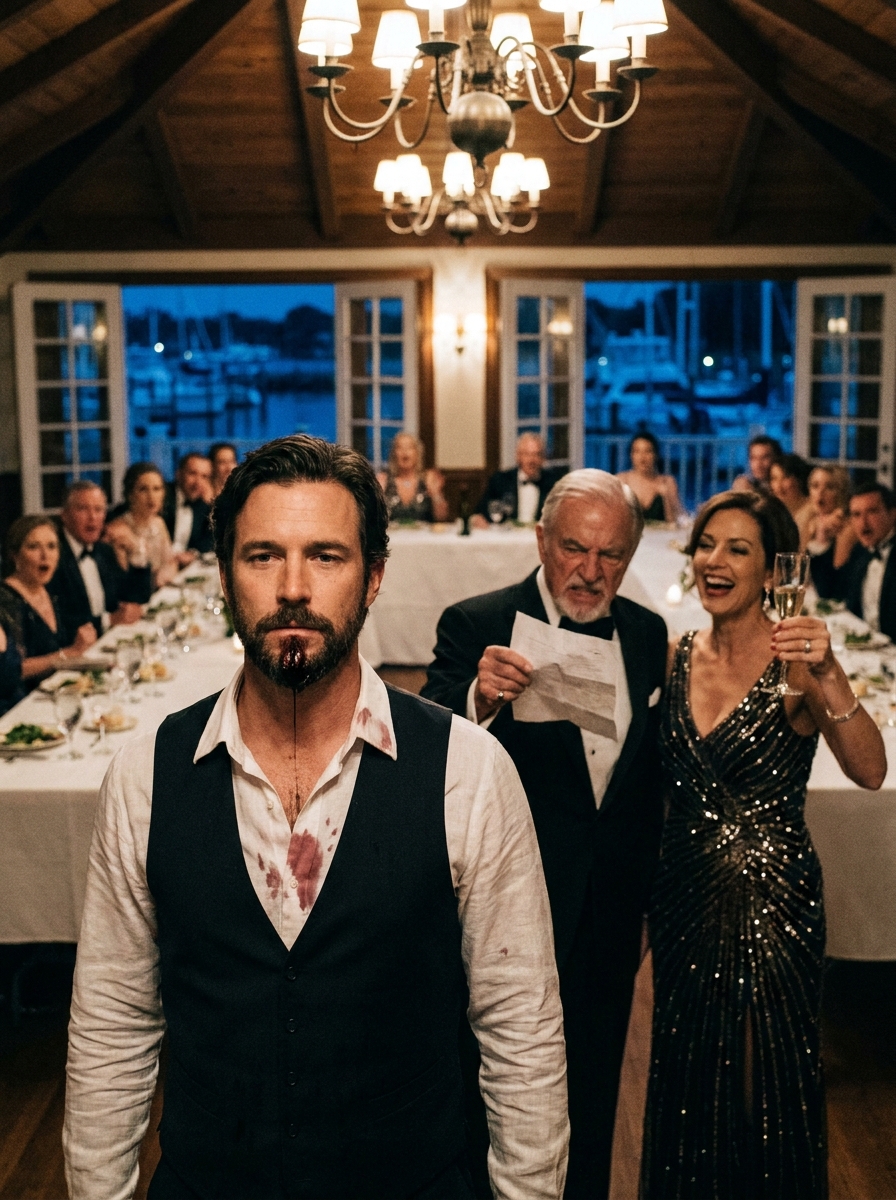
“It’s time, Marcus,” I said, my voice barely a whisper. “He did it. He publicly announced the results tonight at the yacht club.”
There was a long silence on the line.
“Are you certain you want to go through with this, Leo?” Marcus asked, his voice grave. “There is no turning back. It will ruin him.”
“He threatened to bulldoze the workshop tomorrow morning,” I replied, looking out the window at the dark harbor waters. “He wants to erase everything Julian and my mother loved. We go forward.”
“I will file the transition petition with the Stamford probate court at exactly 9:00 a.m. tomorrow,” Marcus said. “I’ll see you at the mansion.”
I spent the rest of the night working.
I sanded a slab of black walnut until my hands were raw, letting the physical labor clear my mind.
At 8:30 the next morning, the sun was shining brightly over the harbor.
I parked my truck in the circular driveway of the Vance estate, a sprawling $24 million limestone mansion overlooking the sound.
A massive yellow excavator was already idling on the grass near my workshop down the hill.
Arthur stood on the mansion’s terrace, a cup of espresso in his hand, wearing a silk robe.
When he saw me get out of the truck, his face contorted in rage.
“I told you to get off my property, Leo!” he roared, striding down the stone steps. “The police have already been notified. You are trespassing!”
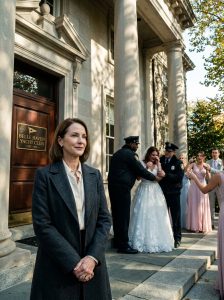
Two police cruisers pulled up the driveway right behind my truck.
Arthur smirked, gesturing to the officers.
“Arrest him,” Arthur ordered the sergeant. “He was evicted yesterday. He has no right to be here.”
Before the sergeant could speak, a black Mercedes sedan pulled up.
Marcus Vance stepped out of the back seat, clutching a thick leather briefcase.
Arthur froze, his face pale. “Marcus? What are you doing here? You retired five years ago.”
“I came out of retirement to execute a mandate, Arthur,” Marcus said, his voice echoing in the morning air.
He handed a sheaf of stamped legal documents to the police sergeant first, then stepped toward Arthur.
“As of 9:02 a.m. this morning, the Stamford Probate Court has verified the genetic profile of Leo Vance,” Marcus declared, holding out a certified copy of the court order.
Arthur scoffed, though his hand shook as he took the paper. “What nonsense is this? He isn’t my son! I proved it last night!”
“He isn’t your son,” Marcus agreed calmly. “He is Julian’s son.”
Arthur’s face drained of color, turning a sickly shade of gray.
“Julian?” Arthur whispered, his eyes darting frantically across the legal pages. “No. That’s impossible. Julian died before…”
“Julian and Sarah were together before the accident,” Marcus said. “The DNA profile matches Julian’s preserved genetic samples with a 99.98% certainty. Under section twelve of your father’s trust, all assets, including this house, the shipping line, and the land your construction crew is currently occupying, have immediately transferred to Leo.”
Arthur stumbled back a step, his espresso cup slipping from his fingers and shattering on the limestone driveway.
“This is a lie!” Arthur screamed, his voice cracking. “I am the trustee! I run this family!”
“Not anymore,” Marcus replied. “The trust has been transitioned. Leo is the sole owner. Furthermore, we have filed an immediate freeze on all corporate accounts pending a full forensic audit of the $14 million you withdrew for your real estate ventures without beneficiary consent.”
Evelyn, my stepmother, had run out onto the porch in her robe, her eyes wide with terror as she listened to the lawyer.
“Arthur?” she shrieked. “What is he talking about? What do you mean the accounts are frozen?”
Arthur didn’t answer. He looked at me, his eyes filled with a desperate, animal panic.
“Leo,” he stammered, stepping toward me. “Son… we can talk about this. I was angry last night. The pressure of the business…”
“I am not your son, Arthur,” I said quietly.
I turned to the police sergeant.
“Sergeant, the construction crew at the harbor is currently trespassing on my property,” I said. “Please have them remove their equipment immediately.”
The sergeant nodded, tipped his hat, and walked toward his cruiser.
Arthur sank onto the stone steps, his face buried in his hands, realizing that the empire he had spent decades stealing had vanished in a single morning.
Three weeks later, the audit was completed.
Arthur was forced to sell his personal assets, including his yachts and his penthouse in Manhattan, to avoid criminal prosecution for trust embezzlement.
He and Evelyn moved into a small rental apartment in Bridgeport, completely ostracized by the Greenwich social circle they had spent their lives trying to impress.
I did not tear down the mansion.
I donated it to a local foundation that provides housing and training for young craftsmen and artists.
As for me, I went back to my workshop.
I sat at my workbench, the smell of fresh cedar filling the humid afternoon air, and picked up my hand plane.
For the first time in my life, the land beneath my feet was truly mine.