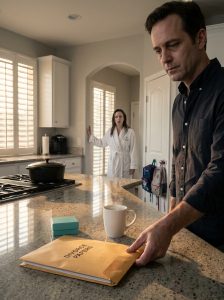
On it was a single PDF Gerald had sent me three days prior. One page. Notarized. A joint checking account opened at Regions Bank in Decatur, Georgia, in the names of Courtney Anne Marsh and Derek Lewis Faulkner.
Opened eleven days before our divorce was finalized.
With an opening deposit of forty-three thousand dollars — money traced to the sale of a rental property Courtney owned jointly with her sister, a property that was never once mentioned in our settlement paperwork.
I didn’t say any of that out loud. I just held the phone up and let her read it.
Her face changed.
Not all at once. Floor by floor, like a building coming down on itself. First her eyes moved across the screen. Then her jaw shifted. Then the envelope in her hand dropped about three inches, as if it had suddenly gotten heavier.
I put my phone back in my jacket.
“Gerald says hello,” I said.
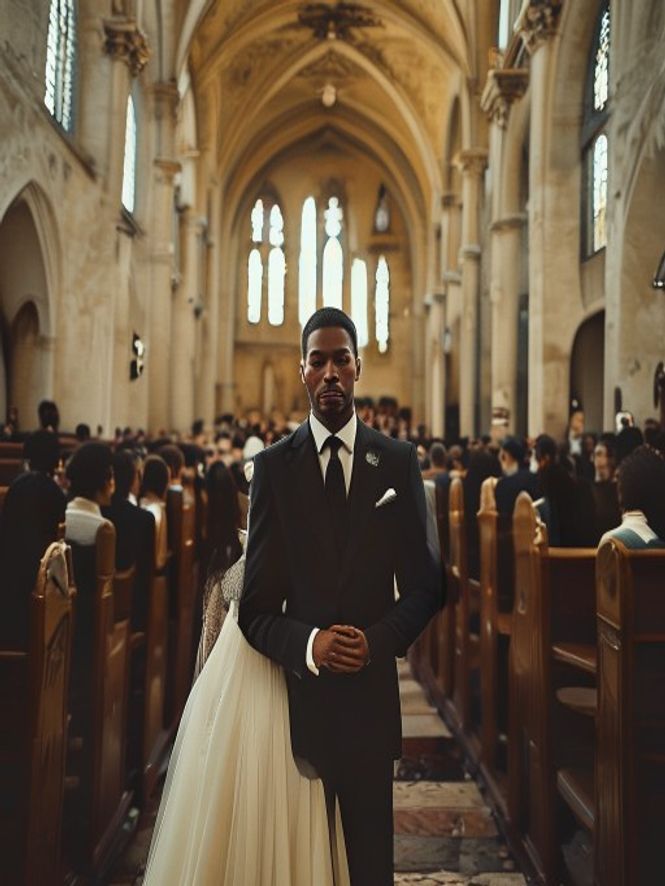
Two off-duty Savannah PD officers had been stationed in the vestibule since 1:45 p.m. — friends of Marcus, arranged Thursday night. At Pastor Roberson’s signal, they came down the aisle.
Courtney looked at them. Then at me. Then at Rachel, who had not moved a single inch.
Rachel was still holding both my hands. Her face was calm in a way I will never stop being grateful for.
“You need to come with us, ma’am,” said one of the officers, whose name tag read Davenport.
“I just — I have documents —”
“You’re welcome to bring those.”
“He hid money from me. He stole from me during our divorce.”
“Ma’am.”
She turned to the pews then. Two hundred and fourteen faces looking back at her. And in the very last row — having slipped in quietly without anyone noticing — sat Courtney’s own mother, Barbara, a stout woman from Macon who had always been kind to me during the marriage.
Barbara was watching her daughter with an expression that was not sympathy.
Courtney’s chin went up. She looked back at me one final time.
“You planned this,” she said.
“No,” I said. “You planned this. I just prepared for it.”
She left. Both officers walked her out through the heavy wooden rear doors, which swung shut behind them with a sound like a period at the end of a very long sentence.
For three full seconds, the church was silent.
Then someone in the third row started to clap.
Then another. Then a section in the middle. Then the whole room, all two hundred and fourteen people rising, and Pastor Roberson was smiling wide, and Rachel was squeezing my hands so hard the bones shifted, and her father in the front row put his face in his palms and shook with laughter.
We got married.
Pastor Roberson kept the vows unhurried. The stained-glass light moved slowly across the stone floor. Rachel’s voice didn’t waver once. Mine almost did, near the end, but I held it.
The reception was at The Cotton Sail Hotel on River Street. The Savannah River ran iron-gray below the balcony, moving fast. We danced to a Norah Jones song Rachel had loved since college. Her father danced with her after. I danced with my mother, who kept whispering “I’m fine, I’m fine” while she cried on my shoulder.
Marcus gave a toast that ran six minutes over and made the room laugh three separate times.
It was exactly what it should have been.
Two weeks later, Gerald sent me his formal report and forwarded a copy to my divorce attorney, Sylvia Crane, as I’d asked him to.
Sylvia filed for a post-decree modification on grounds of fraud and asset concealment. The filing cited the Regions Bank account, the rental property sale, and three additional undisclosed transactions Gerald had traced — totaling just over ninety-one thousand dollars Courtney had moved in the eight months before our divorce was finalized.
As for the documents she’d carried into that church — the ones claiming I’d hidden a hundred and sixty thousand — a forensic accountant Sylvia retained examined them within the week. The account numbers on the statements didn’t correspond to any financial institution linked to my Social Security number. The documents were fabricated. Poorly.
Courtney’s own attorney withdrew from her case in June.
In August, a Fulton County judge ordered her to pay restitution of sixty-seven thousand dollars — the portion of concealed assets the court could definitively trace — plus Sylvia’s legal fees.
Derek did not stay through any of it. I heard through Marcus that he left about six weeks after the wedding, having apparently known nothing about what she’d planned and wanting no part of what followed.
I don’t know what Courtney’s life looks like now.
I don’t spend any part of my day thinking about it.
Rachel and I honeymooned in Asheville. Not because we couldn’t afford farther, but because she’d wanted to return to the Blue Ridge Parkway since a road trip she took with her parents when she was nine years old. We hiked Craggy Gardens in the rain. We ate at a small place on Lexington Avenue where the owner came out and talked to us for forty minutes about his tomatoes.
We came home to our house in Ardsley Park on a Sunday evening in late April. I carried her across the threshold, which she pretended to find embarrassing and clearly loved. Her beagle, Rupert — five years old and not remotely apologetic about his feelings — met us at the door and cried until she picked him up.
I stood in our kitchen at seven in the evening with the last daylight coming in over the sink, and I thought about lying in that hotel room the morning of my wedding, the river smell through the window, telling myself nothing was going to stop it.
Einführung Der Herbst ist eine Jahreszeit voller erstaunlicher Naturerscheinungen. Während die Blätter sich färben und die Temperaturen fallen, bringt der Herbst auch besondere Vögel hervor, […]
Jo Naylor/Flickr/CC by 2.0 Many birders show great compassion for backyard birds, and baby birds can be especially endearing with their soft plumage, fluttering wings, and insistent cheeping. […]