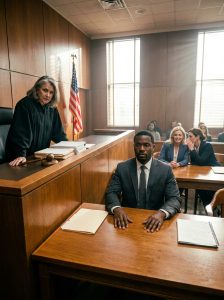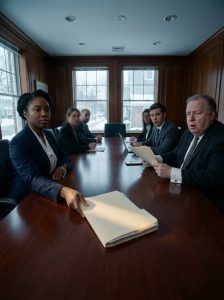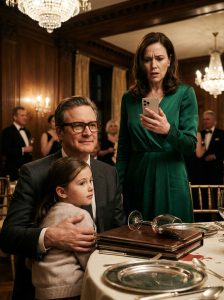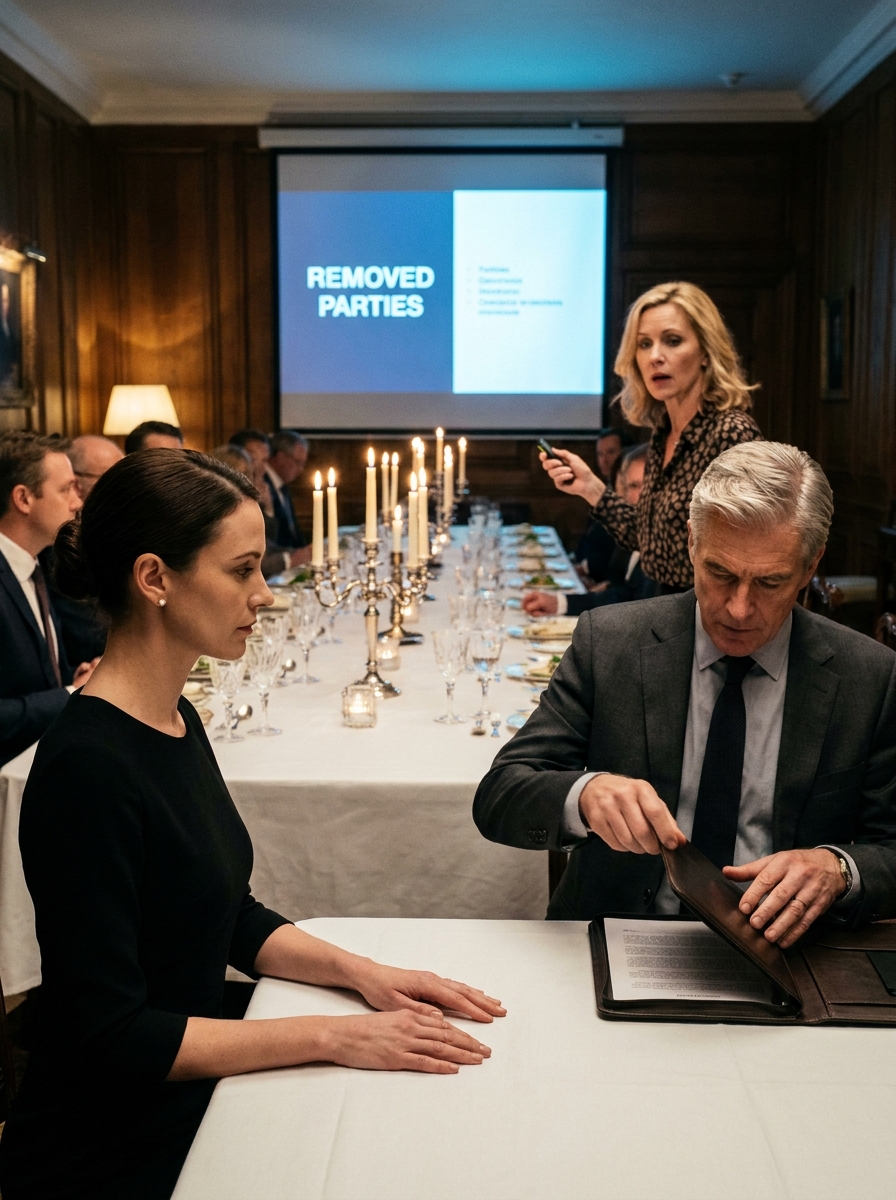
Martin didn’t stand up right away.
He set the folio flat on the table, smoothed one hand across the cover, and let the room stay quiet for exactly long enough that Diane turned to look at him.
“I’m sorry,” she said. “And you are?”
“Martin Okafor. I’m a licensed estate-planning attorney with the firm of Okafor and Associates in Westport. I’ve been retained by Clara Calloway in connection with the estate of Eleanor Diane Calloway.”
The room did something I had never seen a room do before.
It didn’t gasp. It didn’t buzz. It contracted — like forty people had all drawn one small breath inward at the same moment and held it.
Diane’s face went the color of old concrete.
“That’s not possible,” she said.
“The revised trust was executed February 19th,” Martin said. “Witnessed by two nurses on the fourth floor of Stamford Health, notarized by a traveling notary your mother’s firm had on retainer, and recorded with the Fairfield County Clerk’s Office on February 20th at 11:48 a.m.”
He slid a document across the table toward Diane.
She didn’t touch it.
“Your mother named Clara as sole successor trustee and primary beneficiary of the Eleanor D. Calloway Revocable Living Trust, with the exception of specific bequests to other family members already noted in the addendum.” Martin tapped the folio. “Those bequests are intact. The restructuring plan you’ve presented this evening has no legal standing.”
Diane’s attorney — a man named Geoffrey who had driven up from the city — leaned over and murmured something in her ear.
Her jaw tightened.
“This will be contested,” she said.
Martin nodded. “That’s your right.”
“She was ill,” Diane said. “She wasn’t competent.”
The room shifted. Aunt Rosemary made a small sound.
“Eleanor Calloway was evaluated by a licensed clinical neuropsychologist on February 18th,” Martin said. “The evaluation is in the record. She scored in the high-normal range on all cognitive assessments. There are also forty-seven days of nursing notes, three attending physician reports, and a video statement your mother recorded on February 19th immediately after signing, in which she explains her reasoning in considerable detail.”
He paused.
“In the video, she also addresses the wire transfers.”
The table went still.
Geoffrey leaned in again. Diane pulled away from him.
“What wire transfers?” she said. Her voice had lost its shape entirely.
“Forty-three months of transfers from the Norwalk rental income account to an LLC registered in Delaware under a name that does not appear anywhere in the Calloway estate records,” Martin said. “The total, as of your mother’s date of death, is approximately $214,000.”
Aunt Rosemary said, “Oh, Diane.”
Cousin Marcus pushed back from the table.
My son Tyler — seventeen years old, built like his grandfather — sat very straight in his chair and said nothing.
Diane looked at me for the first time since Martin had opened the folio.
I looked back at her.
I didn’t say anything. There was nothing I needed to say.
Geoffrey withdrew from representation within the week.
Diane retained new counsel out of a Midtown firm. They filed a challenge in Fairfield County Probate Court in late April on the grounds of undue influence and lack of testamentary capacity.
The judge reviewed the neuropsychological evaluation. The nursing notes. The three physician reports. The video.
The challenge was dismissed in full on a Thursday morning in June, at 10:15 a.m. I was in the courtroom. Diane was not.
The Connecticut Attorney General’s office opened an inquiry into the wire transfers in late May. I was not involved in that filing. Martin had reported the discrepancy as part of his fiduciary obligations, and the rest moved forward without me.
I don’t know exactly where Diane’s case stands today. I know Geoffrey is no longer her attorney. I know the Upper East Side apartment went back to the landlord in July.
I know, because Aunt Rosemary told me, that Diane called her in August and asked if the family could “show some grace.”
Rosemary said she’d have to think about it.
I sold the Darien strip. I set up education accounts for Tyler and Noah that will cover college in full. I kept the Norwalk properties because Mom had loved her tenants — a retired postal worker named Gerald who had been there eleven years, and a young woman finishing her nursing degree at UConn — and because the income, managed properly, is steady and quiet.
The Greenwich house, I kept.
I replaced the blinds in Mom’s old bedroom with ones that let more light in.
On the first Saturday in October, I sat in the backyard alone — the one that touches the edge of Binney Park — with a cup of coffee and the last book Mom had been reading when she died.
The air smelled like woodsmoke and cut grass.
It was 58 degrees and the leaves had just turned.
I stayed out there until the light ran out.